I created Héritage Sauvage after more than twenty years spent professionally designing journeys through Africa, and a lifetime connected to the continent that goes back much further.
Over the years, I have seen the way people travel evolve, along with their expectations, the places they stay and the destinations themselves. But above all, I have become convinced of one thing: a journey through Africa should never begin with a catalogue of places to stay or a collection of lodges. It should begin with the person who will experience it.
Understanding what they are looking for, what moves them, their pace, their wishes and their limits. Then bringing all of that together with the realities on the ground: the seasons, the distances, the regions and the experiences that will genuinely mean something to them.
That is why I created Héritage Sauvage: to regain the freedom to advise independently, to recommend what I believe is right, leave out what isn’t, and devote my expertise to one interest alone: that of the traveller.
I am not trying to design the journey that looks most impressive on paper.
I am trying to design the one that will truly be right for you.
Raphaël Soulié
Founder of Héritage Sauvage

1945
In 1945, my great-uncle Marcel and Tinou Soulié settled in Cameroon, then under French administration. They built a life there that became deeply connected with the country’s development and with travelling across its vast territory.
They were involved in the management of N’Gaoundéré airport, were shareholders in Air Cameroun, developed car dealerships and garages, and operated a road transport company linking the south and north of the country.
Their lives took them across Cameroon, from the forests of the south to the Adamawa Plateau, the North and the Far North. At the time, they also took part in African big-game hunting, something that belongs to a very different era and a very different relationship with wildlife from the one we have today.
My family’s African story begins with Marcel and Tinou: a story of vast territories, roads, aviation, adventure and an intimate knowledge of the country gained by travelling through it.


1970
I had just been born when my great-uncle Marcel persuaded my parents to change their lives and join the family in Cameroon. My father, then an electrician with EDF in France, became Air Cameroun’s station manager in N’Gaoundéré.
Already living there were Marcel and Tinou’s daughter Rita and her husband, Jean Vannier, a renowned professional hunting guide, based on the family concession.
This was the world in which I grew up, between two cultures. On one side, a European family still deeply influenced by the customs and codes of another era; on the other, the Cameroon I experienced every day, particularly through my school friends.
From a very early age, I was drawn to nature, animals and, above all, the immensity of the landscape. Visiting family friends on sometimes very remote concessions became extraordinary experiences: days on the road, changing landscapes, encounters along the way, and the feeling that the world was infinitely larger than the place in which we lived.
Looking back, I believe much of my relationship with Africa began there: in that curiosity for what lies beyond the horizon, and in the pleasure of travelling through a land in order to meet the people who live there.
1988
I spent several years in Gabon with the French Army, based at Camp de Gaulle in Libreville, home to the 6th Marine Infantry Battalion.
They were years of contrasts. Military life imposed an extremely strict framework, with little freedom and constraints that sat uneasily with the person I already was. Whenever I could, I looked elsewhere for the sense of freedom I was missing.
Outside my military duties, I worked in civilian life for UTA at Libreville Airport. Gradually, I built a life beyond the camp, made many friends and, through them, discovered a Gabon of extraordinary richness.
The equatorial rainforest, the gorillas of Loango, forest elephants, the famous hippos venturing into the Atlantic surf, the beaches of Pongara where leatherback turtles come ashore to lay their eggs… And then the nights spent camping far from everything, at Cap Estérias or Pointe Denis.
Paradoxically, those difficult years gave me some of my greatest memories of Africa. I came to understand just how essential freedom, vast open spaces and the feeling of being far from the rest of the world are to the way I experience a place.
They are sensations I still look for today when imagining a journey.

1991
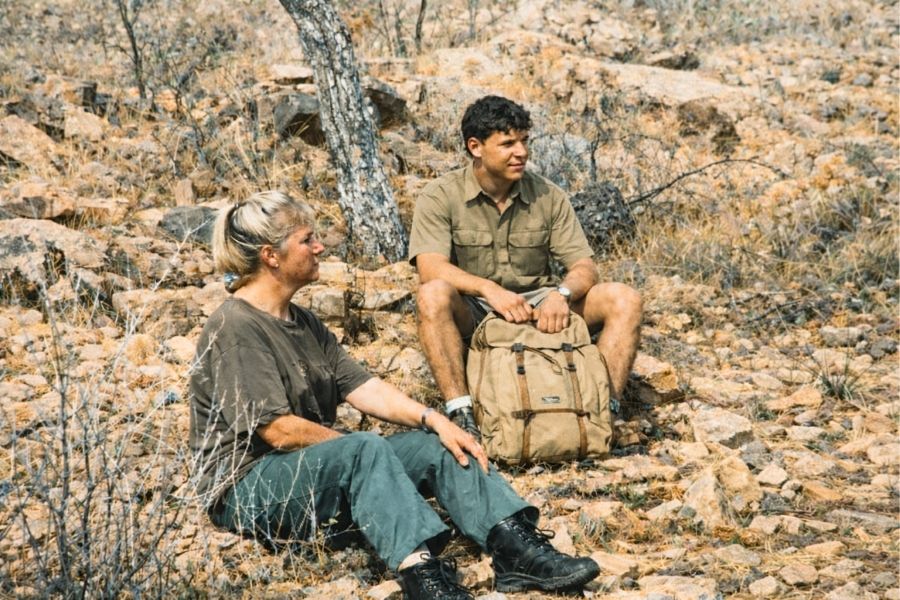
I moved to Namibia to manage a 10,000-hectare African farm near the small town of Otjiwarongo. My daily life revolved around keeping this vast property running: logistics, provisions, the house, fences, windmills and the water tanks essential for storing water.
Springbok, zebra, Cape eland, ostrich, greater kudu, waterbuck and many other antelope roamed the land. Living among them, I deepened my knowledge of wildlife, animal behaviour and this extraordinary environment day after day.
I became a safari guide, then created my first safari company. I began working with leading Paris-based travel companies, accompanying their clients through a country that had only recently gained its independence.
I shared what I had learned in the field, but also my favourite places, routes and a few closely guarded secrets, exceptional places you discover by living in a country, long before they find their way into established travel itineraries.
For the first time, my knowledge of Africa truly became my profession: understanding a place, knowing where to go and, above all, wanting to share it with others.
1996
I wanted to go further. Travelling by 4x4, I set out to explore the vast wilderness of Kaokoland, before gradually extending my horizons to South Africa, Botswana and Zimbabwe.
I discovered Cape Town, which immediately captivated me, and took an apartment there as my South African base. From there, I covered thousands of kilometres and guided safaris through natural environments very different from those I had come to know in Namibia.
In Botswana and Zimbabwe, I worked as a safari guide alongside other guides. Deserts, savannahs, deltas, rivers and reserves followed one another, each revealing different ways of approaching wildlife and understanding a landscape. I was in my element.
The world of safari was evolving too. I experienced a new generation of camps and lodges, increasingly comfortable and sometimes genuinely luxurious, but also better integrated into their surroundings and gradually becoming more conscious of their impact on the natural environment.
Those years broadened my understanding of safari: there is no single wild Africa, but a multitude of landscapes, ecosystems and ways of experiencing them.


2004
I returned to France and joined Voyageurs du Monde as Southern Africa Product Manager. After years spent in the field, I discovered another dimension of my profession: turning that intimate knowledge of Africa into journeys designed entirely for others.
I created itineraries for discerning travellers looking for vast open spaces, a return to nature and highly exclusive safari experiences. I learned to listen to their expectations, understand what they were genuinely seeking and translate their wishes into coherent experiences and itineraries.
At the same time, I continued exploring the continent, venturing into an Africa I knew far less well: East Africa, the historic birthplace of safari as it came to be portrayed and popularised in the Western imagination, although, of course, encounters with wildlife had long been part of life and travel elsewhere on the continent, including in the Cameroon of my childhood.
I quickly became familiar with these now emblematic, sometimes iconic landscapes: immense savannahs, dazzling coastlines and, above all, concentrations of wildlife on a scale I had never experienced before. At the time, some of these places still saw remarkably few visitors. Finding myself surrounded by vast herds, sometimes with the feeling of being almost alone among them, remains etched in my memory.
But those years were also about people. Across East Africa, I built relationships with guides, travel professionals and personalities from the safari world, some of whom became friends and remain so today.
Those relationships, built over many years, are now an integral part of my expertise: knowing a place also means knowing the people who can truly bring it to life.
2019
I joined another French tour operator and took responsibility for its Africa department. Then Covid abruptly disrupted the travel industry and exposed some of its limitations.
As travel resumed, I saw an evolution that had already been troubling me begin to accelerate: travel in Africa was becoming increasingly standardised. Itineraries became shorter and faster. Travellers were expected to see more, move constantly, accumulate experiences and return home feeling they had “done it all”.
But in trying to do everything, we sometimes end up experiencing very little.
I continued travelling through the places that had shaped me and observing what was happening on the ground. More than ever, I realised that Africa asks for almost the opposite: time, attention, patience, respect and sometimes simply the ability to stop.
As head of the Africa department, I defended that vision, but it increasingly came up against an approach that was no longer mine. I was expected to follow formulas I no longer believed in, design journeys faster and gradually turn travel into something easier to sell and consume.
That was no longer how I wanted to experience or represent Africa. A safari is not a succession of animals to tick off a list. A landscape is not a backdrop. And the people and cultures we encounter are not experiences to be added to an itinerary.
I came to understand that the very things that had always drawn me to travel, nature, vast spaces, encounters, time and freedom, could easily disappear when journeys became too formulaic.
The idea of finding another way to practise my profession was beginning to feel like a necessity.


2024-2025
In 2024, I experienced burnout. After all those years devoted to Africa and travel, I was forced to stop.
That pause became a time of profound reflection. At 57, I began to question the meaning of my work, what I wanted to do with the knowledge accumulated over a lifetime, and above all how I still wanted to share it.
I chose independence and created Héritage Sauvage to step away from a certain kind of travel industry in which I no longer recognised myself, and return to my own vision of what travelling through sub-Saharan Africa should be.
An Africa that is not rushed through. Less-visited places whenever that is still possible. Genuine emotions rather than an accumulation of experiences. And above all, encounters with people who know their environment intimately, share the same values and want, in turn, to pass on what they know.
I want to make room again for the unexpected and the spontaneous. Not everything needs to be staged, and nature should never be expected to deliver on command. A wild animal is precisely that: wild. It may appear or disappear. An encounter, a particular light, a moment of silence or an unexpected conversation may ultimately become the most precious memory of a journey.
Héritage Sauvage was created for travellers looking for something different. Not a standard journey slightly adjusted from one client to the next because it needs to be sold quickly, but a journey that begins with them: who they are, what they are looking for and what they genuinely want to experience.
After all these years, I do not simply want to continue designing journeys. I want to pass on a certain way of experiencing Africa.
What I transmit is not a product, but a way of being in Africa.


It all starts with a conversation.
Tell us about the way you like to travel, what inspires you and what you would love to experience in Africa, even if you don’t yet know exactly where you want to go.
This first conversation will help us understand what you are looking for and how Héritage Sauvage can best support you.